STEP
Approximates the Heaviside step function with a cubic polynomial.
Notes: | STEP has continuous first derivatives, but its second derivatives are discontinuous at x=x0 and x=x1. Haversine Step (HAVSIN), STEP5, and TANH offer other approximations for the Heaviside step function. These have a higher degree of continuity and differentiability, but can have larger derivatives. See Haversine Step (HAVSIN) for a plot comparing STEP, STEP5, TANH, and Haversine Step (HAVSIN). |
Format
STEP (x, Begin At, Initial Function Value, End At, Final Function Value)
Arguments
x | Independent variable. |
Begin At or x0 | Value of independent variable at which the STEP function begins; defined by a real number, an expression or a design variable. |
Initial Function Value or h0 | Initial value of the step; defined by a real number, an expression, a design variable or a run-time function. |
End At or x1 | Value of independent variable at which the STEP function ends; defined by a real number, an expression or a design variable. |
Final Function Value or h1 | Final value of the step; defined by a real number, an expression, a design variable or a run-time function. |
Extended Definition
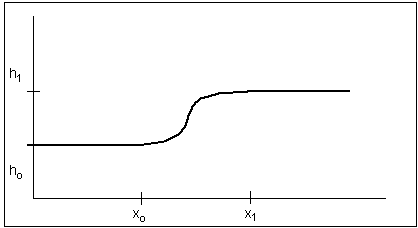
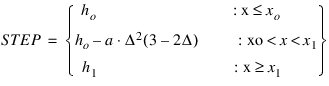
The STEP function approximates the Heaviside step function with a cubic polynomial. The following figure illustrates the STEP function.
The equation defining the STEP function is:


Example
Using a cubic polynomial, the following function defines a smooth step function from 3 to 4, with a displacement from 0 to 1:
STEP((2, 3, 3.5, 4, 5), 3, 0, 4, 1)
This example produces the following results:
0.0, 0.0, 0.5, 1.0, 1.0