Velocity Along Line-of-Sight (VR)
Returns the radial (relative) velocity to one coordinate system marker from another. The vector time derivative is taken in a reference coordinate system marker.
When the two markers move away from each other, VR is positive. When the two markers approach each other, VR is negative.
Format
VR (To Marker, From Marker, Reference Frame)
Arguments
To Marker | (Required) The coordinate system marker whose velocity is being measured. |
From Marker | (Optional) The coordinate system marker whose velocity is subtracted off. If you don't specify this argument, it defaults to the global origin. |
Reference Frame | (Optional) The coordinate system marker in which the time-derivatives are calculated. If you don't specify this argument, it defaults to the ground reference frame. |
Equation
Mathematically, VR is calculated as follows:
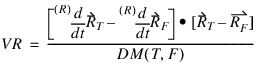
where:
■ is the position vector from the global origin to the To Marker, T.
is the position vector from the global origin to the To Marker, T.■ is the time-derivative of
  with respect to the Reference Frame, R.
is the time-derivative of with respect to the Reference Frame, R.■ [ is the position vector from the global origin to the From Marker, F.
[ is the position vector from the global origin to the From Marker, F.■ is the time-derivative of
  with respect to the Reference Frame, R.
is the time-derivative of with respect to the Reference Frame, R.■DM(T,F) is the distance between the To Marker, T, and the From Marker, F.
Example
The following function returns the radial (relative) velocity of the velocity vector between marker_T and marker_F. The vector time-derivative is taken in the reference frame of marker_R.
VR(marker_T, marker_F, marker_R)