Velocity Along Z (VZ)
Returns a z component of the difference between the velocity vectors of two coordinate system markers.
Format
VZ (To Marker, From Marker, Along Marker, Reference Frame)
Arguments
To Marker | (Required) The coordinate system marker whose velocity is being measured. |
From Marker | (Optional) The coordinate system marker whose velocity is subtracted off. If you don't specify this argument, it defaults to the global origin. |
Along Marker | (Optional) The coordinate system marker along whose z-axis the velocity is measured. If you don't specify this argument, it defaults to the global z-axis. |
Reference Frame | (Optional) The coordinate system marker in which the time derivatives are calculated. If you don't specify this argument, it defaults to the ground reference frame. |
Equation
Mathematically, VZ is calculated as follows:
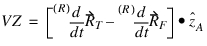
where:
■ is the position vector from the global origin to the To Marker, T.
is the position vector from the global origin to the To Marker, T.■ is the time-derivative of
  with respect to the Reference Frame, R.
is the time-derivative of with respect to the Reference Frame, R.■ is the position vector from the global origin to the From Marker, F.
is the position vector from the global origin to the From Marker, F.■ is the time-derivative of
  with respect to the Reference Frame, R.
is the time-derivative of with respect to the Reference Frame, R.■ is the unit vector along the z-axis of the Along Marker, A.
is the unit vector along the z-axis of the Along Marker, A.Example
The following function returns the z component of the velocity vector between marker_T and marker_F. The vector is expressed in the coordinate system of marker_A. All time-derivatives are calculated in the reference frame of marker_R.
VZ(marker_T, marker_F, marker_A, marker_R)