Introduction
Use Adams Acoustics plugin to understand how a tuning fork will vibrate during normal operation and perform an Actran-based time-domain acoustics analysis.
Model Description
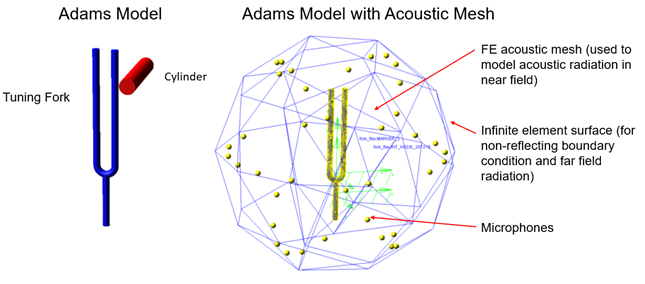
■A tuning fork is vibrating in the far field
■A cylinder is used to excite the tuning fork
■Finite element acoustic mesh is used to model the acoustic radiation in the near field
■Infinite element surface is created for nonreflecting boundary condition and far field radiation
■Microphones are automatically included in the acoustic mesh
Eigen Modes of Tuning Fork
■6 Rigid body modes
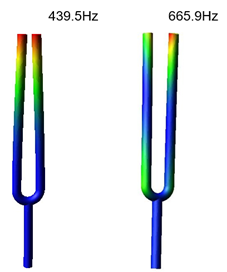
■The first eigenmode is at 439.5Hz which is expected to drive the far field radiation
■The second eigenmode is at 665.9Hz
Process
■The Adams model of a flexible body tuning fork is simulated and the vibrations of it are calculated by Adams Solver
■The tuning fork radiates in the free field
♦The free field radiation is computed with Actran
♦A finite fluid component is defined around the tuning fork
♦An infinite fluid component is used for the free field condition and non-reflecting boundary conditions
♦A BC_MESH boundary condition is used to apply the vibrations of the tuning fork
♦A coupling surface component is created to support the vibrations of the tuning fork