What You Will Create
In this tutorial, you will build a latch model that is required to securely clamp two halves of large shipping containers together. The latch design problem is based on a latch developed by Earl V. Holman of North American Aviation, Inc., Downey, CA, under contract to the Manned Spacecraft Center in Houston. This latch is one of twelve used to clamp the Lunar Excursion Module to the Command and Service Module in the Apollo program.
Figure 2 shows an illustration of the physical model of the latch.
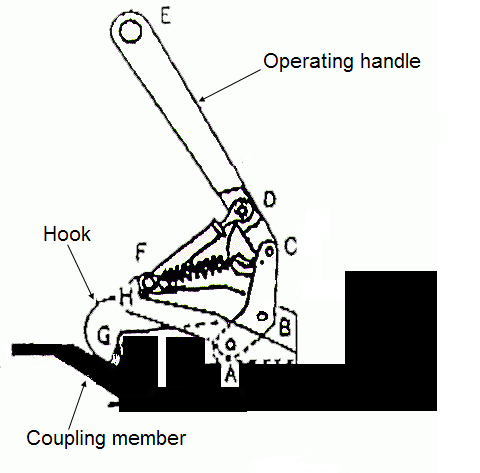
Figure 2 Physical Model of Hand Latch Design
Design Requirements
The latch model must meet the following design requirements:
■Exerts at least 800 N clamping force.
■Is hand-actuated by less than 80 N force.
■Is hand released with minimal effort.
■Must work within a given envelope.
■Clamping remains secure under vibration.
How the Latch Model Works
Figure 3 shows a virtual model of the latch. The latch is clamped by pushing down on the operating handle at POINT_4. This causes the pivot to rotate around POINT_1 in a clockwise direction, drawing back POINT_2 of the hook. As this happens, POINT_8 of the slider is forced downward. Finally, as POINT_8 passes through the line between POINT_9 and POINT_3, the clamping force reaches its maximum. POINT_8 should move below the line created by POINT_3 and POINT_9, followed by the operating handle coming to rest on the top of the hook. This sets the latch near the maximum force point, but allows a reasonable release force to open the latch.
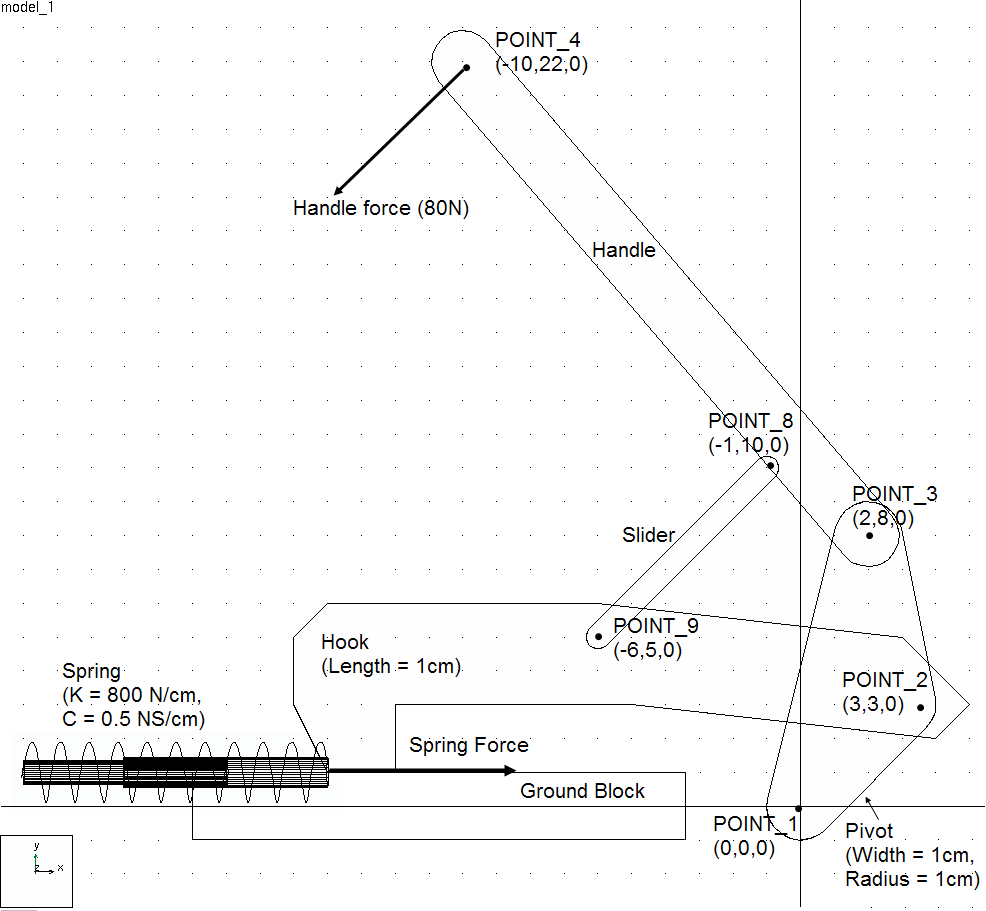
Figure 3 Adams View Latch Model
Based on the description of the latch operation, the relative layout of POINT_1 through POINT_9 is important in ensuring that the latch will meet the design requirements. Therefore, when your latch model is assembled and tested, you need to change the relative locations of the points to see their effect on the design requirements.