Contact Force
The contact force between two parts is defined by a modified impact function for a penetration larger than zero. The force is zero when there is no penetration. The modified impact function uses a scale factor while the standard impact function doesn't.
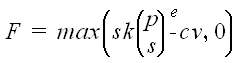
where:
■s = Scale Factor
■k = Stiffness
■e = Exponent
■p = Penetration
■v = Velocity
■c = Effective damping coefficient with a value of Damping, cmax, for a penetration larger than Penetration Depth, d, as shown next.
Impact Damping
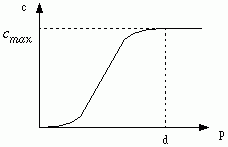
You can design your contact force law by changing stiffness, exponent, and scale factor. Figure Impact Stiffness shows the influence of scale factor and stiffness on the stiffness force. The graph shows three different examples with scale factor s2 much larger than s1 and stiffness k2 much larger than k1. The exponent is the same for all three examples, and is larger than 1. Figure Impact Exponent shows the influence of the exponent, e. Note that for penetration p=s, the impact force is independent of the exponent.
Impact Stiffness 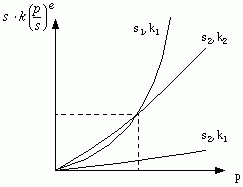 | Impact Exponent 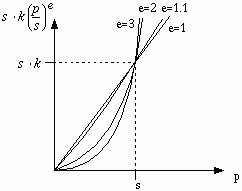 |
Using a scale factor also ensures that the stiffness-force function is independent of the units. The next example illustrates the influence of the scale factor with respect to units. The force function is independent of the length unit when using the modified impact function as shown in figure Impact Scale Factor. When the standard impact function is used, the force function is dependent on the unit of length, as shown in figure Unit-Sensitive Impact; curve A is for [mm] and curve B is for [m].
Impact Scale Factor 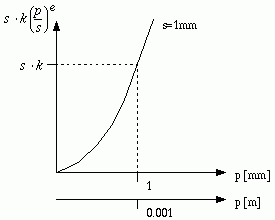 | Unit-Sensitive Impact 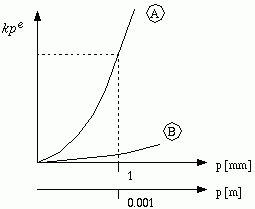 |
Note that the examples are only valid for e > 1.