Reference Condition
It is easy to notice that the displacement field of the element defined by Equation (4) contains the rigid body modes of the element. The intention of FFRF is to describe the rigid body motion by introducing a couple set of absolute Cartesian and rotational coordinates that could account for the location and orientation of the body reference. In doing so, a unique displacement field should be defined, and this requires the rigid body motion modes associated with the element shape functions being eliminated. This can be achieved by imposing a set of reference conditions that consistent with the kinematic constraints imposed on the boundary of the flexible body. The reference condition should eliminate all the rigid body modes which means the number of reference conditions should be equal or more than the number of rigid-body modes. The conditions that define the nature of flexible body reference are called the reference conditions.
In finite-element analysis, the vector of nodal coordinates of body i can be written as  , where
, where is the vector of nodal coordinates in the undeformed state and
  is the vector of nodal deformations. The reference conditions can be considered as a set of linear algebraic equations that used to define the dependent deformation coordinates that expressed in terms of independent coordinates. This leads to the transformation
  , where
  is the matrix of the reference condition and
  is the vector of the independent nodal deformations.
To this end, the position vector of an arbitrary point on element j of body i described in Equation (4) can be uniquely defined as,
 | (5) |
The generalized coordinate of flexible body i can be written in a partitioned from as 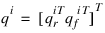 , where
  is the vector of nodal coordinates resulting from the finite element discretization. Such that, the equations of motion of the flexible body i can be written as,
, where is the vector of nodal coordinates resulting from the finite element discretization. Such that, the equations of motion of the flexible body i can be written as,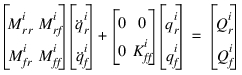 | (6) |
where  and
and  is the positive definite because of imposing the reference conditions that define a unique displacement field.
and is the positive definite because of imposing the reference conditions that define a unique displacement field. 1. A.A. Shabana, Dynamics of Multibody Systems, Cambridge University Press, 2013.
2. A.A. Shabana, G. Wang, Durability Analysis and Implementation of the Floating Frame of Reference Formulation, IMechE J. Multibody Dyn., Vol. 232, Issue 3, 2017.
3. J.J. O’Shea, P. Jayakumar, D. Mechergui, A.A. Shabana, L. Wang, Reference Conditions and Substructuring Techniques in Flexible Multibody System Dynamics, J. Comput. Nonlinear Dyn., Vol. 13, Issue 4, 2018.