Creating and Running an Experiment
Overview
In this section, you’ll create a design matrix and run a model through a number of simulations that you set up in the experiment.
The sections in this tutorial are:
Creating a Design Matrix
This section provides instructions on how to create a design matrix to evaluate the effect that modification of the outer tie rod location has on toe angle.
Automatically Created Factors
Adams Car automatically creates a set of factors in Adams Insight that can be studied. The table below shows some of the Adams Car entities and attributes that can be considered as factors in Adams Insight.
Adams Car Entity | Attribute Affected | Adams Insight Design Factors |
|---|---|---|
Hardpoint | Location | x, y, z |
ac_bushing | Translational Preload | t_preload_x, t_preload_y, t_preload_z |
Rotational Preload | r_preload_x, r_preload_y, r_preload_z | |
Translation Offset | t_offset_x, t_offset_y, t_offset_z | |
Rotational Offset | r_offset_x, r_offset_y, r_offset_z | |
Translational Damping | tx_damping_force_scale, ty_damping_force_scale, tz_damping_force_scale | |
Rotational Damping | rx_damping_force_scale, ry_damping_force_scale, rz_damping_force_scale | |
Translational Stiffness | fx_scaling_factor, fy_scaling_factor, fz_scaling_factor | |
Rotational Stiffness | tx_scaling_factor, ty_scaling_factor, tz_scaling_factor | |
ac_linear_bushing | Translational Damping | fx_damp_scaling_factor, fy_damp_scaling_factor, fz_damp_scaling_factor |
Rotational Damping | tx_damp_scaling_factor, ty_damp_scaling_factor, tz_damp_scaling_factor | |
Translational Stiffness | fx_scaling_factor, fy_scaling_factor, fz_scaling_factor | |
Rotational Stiffness | tx_scaling_factor, ty_scaling_factor, tz_scaling_factor | |
ac_spring | Stiffness | scale_factor |
Installed Length | installed_length | |
ac_linear_spring | Stiffness | stiffness |
ac_damper | Damping | scale_factor_compression, scale_factor_rebound |
ac_bumpstop | Force | scale_factor |
The following rules are used to identify factors in Adams Car models:
Entity Type | Identification Rule: |
|---|---|
Design Variables | dv_* of type integer or real that are children of the assembly |
Hardpoints | hp[lrs]_* |
Parameter Variables | pv[lrs]_* of type integer or real |
User Defined Elements (UDE) | Variables specified in the .design_parameters and .instance_parameters properties |
Anti-roll bars | diameter, thickness, Cratiok, Cratiom, damping_ratio, stiffness, sprung_mass_percent. Parameters depend on the type of anti-roll bar element (.Cratiok, .Cratiom only apply to the FE_PART variant, for example). |
Nrods | outer_radius, inner_radius, damping_ratio, Ixx, Iyy, Izz, area, sprung_mass_percent |
General parts, loading parts | mass, location, cm_location_from_part, Ixx, Iyy, Izz, Ixy, Izx, Iyz, sprung_mass_percent |
Wheel parts | mass, cm_offset, Ixx, Izz, center_offset |
Flexible Bodies | location (x, y, z), index_in_database (MDDB only), sprung_mass_percent |
Reduction & Differential gears (couplers) | reduction_ratio |
Switch Parts | index |
Solver Settings | Typical Dynamics items such as: ERROR, HMAX, CORRECTOR, INTERPOLATE and so on. Typical Equilibrium items such as: ERROR, TLIMIT, ALIMIT, STABILITY, MAXIT and so on. Executable settings: Solver choice, hold_solver_license, thread_count |
Promoting Candidates
The first step required to creating your designed experiment is to select the factors that you want to include in your design matrix. You select factors from the Candidates list in the treeview, and then promote them to the Inclusions list. Promoting candidates to inclusions causes them to become part of your design matrix.
To promote factors from candidates to inclusions:
1. In the treeview, click the + in front of Factors. Factors expands to reveal Inclusions and Candidates.
2. Continue by expanding Candidates, ainsight_susp, TR_Front_Suspension, Hardpoints, and hpl_tierod_outer. Under hpl_tierod_outer, you’ll see a list of factors that you can include in your design matrix.
3. Select the candidate, hpl_tierod_outer.x, and then move your cursor to the Adams Insight toolbar and select the Promote to inclusion tool .
.
. The candidate hpl_tierod_outer.x moves to the Inclusion list under Factors in the treeview.
Tip: | To select more than one factor, hold the Ctrl key as you click. To promote the factors directly from the treeview, press the shortcut key F5. |
4. Continue promoting the following factors:
■hpl_tierod_outer.y
■hpl_tierod_outer.z
The factors move from the Candidates to the Inclusions list.
The factors appear in your treeview as shown in Figure 4.
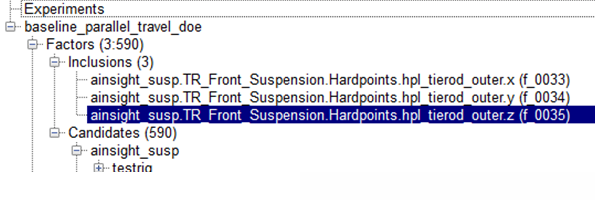
Figure 4 Treeview Showing inclusion Factors
Modifying Your Factors
After you promote your factors, you define parameters for them in the Factor form. To learn more about factor parameters, press the F1 key from the Factor form.
To modify your factors:
1. In the treeview, find the factors in the Inclusions list. Select the factor hpl_tierod_outer.x.
The Factor form appears in the viewport as shown next.
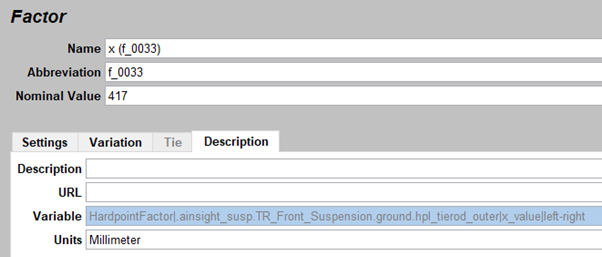
Figure 5 Factor Form
2. In the Factor form, set Abbreviation to tierod_x.
The default Abbreviation text string is automatically generated. Because Adams Insight uses this abbreviation for table column headings, it is a good idea to change the generated text string to something short and meaningful to you.
3. Select the Settings tab, and then enter or verify the following:
■Type: | Continuous |
■Delta Type: | Relative |
■Settings: | -5, 5 |
4. Select the Description tab, and check that Units is set to Millimeter.
The Units parameter is for annotation purposes. The units entered do not affect factor values.
5. Use the defaults for all remaining fields.
6. Select Apply.
Adams Insight saves your factor modifications.
7. Modify the parameters for the remaining factors, hpl_tierod_outer.y and hpl_tierod_outer.z, as you did in Step 2., above, using appropriate abbreviations.
Promoting Responses
Now that you have finished promoting and modifying your factors, the next step is to promote your responses for the experiment.
To promote responses from candidates to inclusions:
1. In the treeview, click the + in front of Responses.
The levels nested under Responses expand to reveal Inclusions and Candidates.
Hint: | You can click the minus (-) sign in front of Factors to collapse that section of the treeview and save screen space. |
2. Continue expanding the levels under Candidates and .default (the name of the Event Set in Car), then baseline (the prefix for the Event in Car) and then ainsight_susp.
The response moves from the Candidates to the Inclusions list.
Modifying Responses
The modifications you’ll make to the responses are minor. You’ll add units and change one of the parameters. To learn more about response parameters, press the F1 key from the Response form.
To modify responses:
1. In the treeview, under Responses, in the Inclusions list, select the response, toe_angle_objective. The Response form appears, shown next, in the viewport.
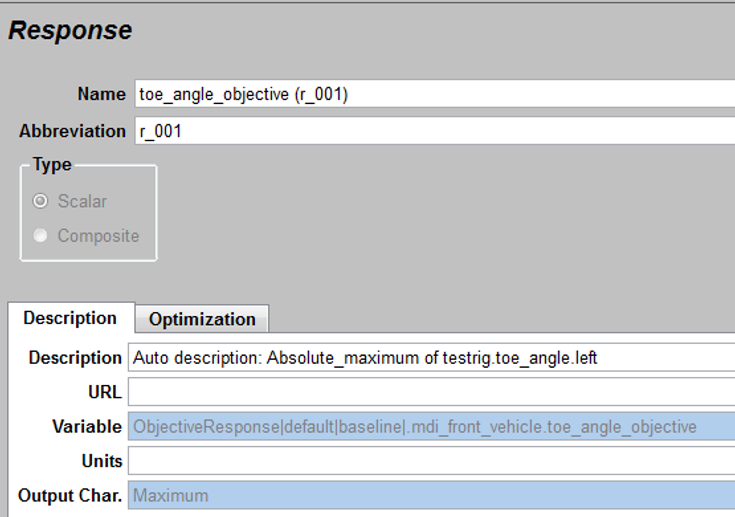
Figure 6 Response Form
2. In the Response form, enter or verify the following:
■Output Char.: | Maximum |
■Abbreviation: | toe_ang |
■Units: | degrees |
3. Use the defaults for all remaining fields.
Note: | Output characteristics are grayed out when you use Adams Insight with Adams View and other Adams applications. The output characteristic is set by the originating CAE application, and is displayed in the Response form for information only. |
4. Select Apply.
Adams Insight saves your response modifications.
Setting Design Specifications
In this section, you’ll set the design objective and design type for your experiment. To learn more about setting design specifications, press the F1 key from the Design Specification form.
To specify your design objective:
1. In the toolbar, select the Set design specification tool  , or in the treeview, expand the levels under Design, and then select Specification. You can also select the Define menu, point to Experiment Design, and select Set Design Specification.
, or in the treeview, expand the levels under Design, and then select Specification. You can also select the Define menu, point to Experiment Design, and select Set Design Specification.The Design Specification form appears in the viewport as shown in Figure 7.
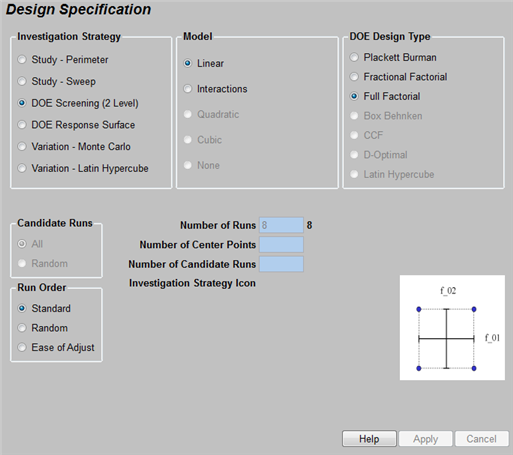
Figure 7 Design Specification Form
2. In the Design Specification form, make or verify the following selections:
■Investigation Strategy: | DOE Screening (2 Level) |
■Model: | Linear |
■DOE Design Type: | Fractional Factorial |
Use defaults for all remaining options.
3. Select Apply.
4. Select the Define menu, point to Experiment Design, and then select Create Design Space.
5. Select the Define menu, point to Experiment Design, and then select Create Work Space.
 in the Adams Insight toolbar performs Steps
 The Work Space appears in the viewport as shown in Figure 8. This table displays the work space matrix for the fractional-factorial experiment that you defined earlier in the tutorial. Adams Car will run a simulation for each trial defined in this matrix. The column headings are sortable and sizeable. You can also select Work Space Review to view summary information for each factor and response in your experiment.
In the treeview, at the Design level, the letters D:W appear to indicate that the Design contains a successfully generated design work space.
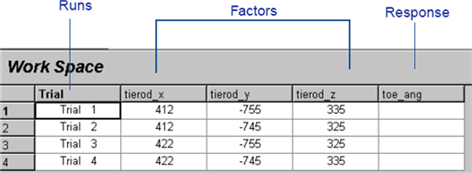
Figure 8 Work Space Matrix Before Running Trials in Adams Car
Note: | Columns appear in the work space matrix in the order that you promote factors for inclusion. |
Tip: | Put your mouse pointer over column headings to display key information about the abbreviation shown. |
Running Your Experiment
Once you’ve verified the information in the Work Space, you’re ready to run the simulations. Save your experiment file in Adams Insight and then close the Insight window to return to Adams Car and run the simulations.
To run the simulation:
After saving the file in Insight and returning to Adams Car, locate the run dialog from the menus in Adams Car: Simulate → DOE Interface → Adams Insight → Run.
Specify the experiment filename as shown below and leave the settings at the defaults:
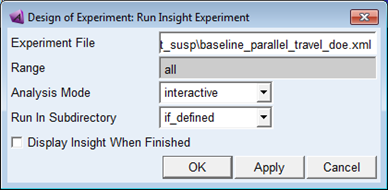
This will run the four trials defined in the experiment.