Bearing Output
Adams Machinery Bearing Output Dialog within Adams View
The bearing output dialog allows one to specify the request components generated during the simulation for post-processing. For the detailed method, in addition to the total bearing force, one can choose to report the stiffness and damping components separately. Also, from this dialog one can alter the default value of failure probability used in a service life prediction based on ISO/TS 16281. This equates to the percentage of bearings that can be expected to fail after the calculated service life duration. The service life duration can be interpreted as the predicted service life in hours for the bearing under the loading and rotational speed conditions at the given time step.
Adams Machinery Bearing Duty-Cycle Service Life within Adams PostProcessor
For the detailed modeling option only, Adams Machinery Bearing calculates a service life estimate at every output step which can be interpreted as the as the predicted service life in hours for the bearing under the loading and rotational speed conditions at that output step. See Bearing Output for details of the inputs to this calculation and Calculation of service life based on the bearing inner geometry (ISO/TS 16281) as for details of the life calculation method according to ISO/TS 16281.
Within Adams PostProcessor one can also generate a "duty cycle" style life output via the "Adams Machinery Bearing Duty-Cycle Service Life" tool. This tool can be launched by selecting "Bearing Life" from the "Tools" menu within Adams Postprocessor. The single-value service life estimate provided by the "Adams Machinery Bearing Duty-Cycle Service Life" tool aggregates the individual service life output values from each output step described above (known as Li in the formulation description, below) over the course of the duty-cycle specified in the dialog box. The formulation used to accomplish this amounts to an "equivalent life" calculation and is described below:

Where:
♦Ltot : single-value service life estimate provided for each bearing by this "Adams Machinery Bearing Duty-Cycle Service Life" tool in units of hours.
♦ti : time length of the Adams output step in hours. For example, if the time from the previous output step to the current output step (the current output step is the one from which Li is taken) is 0.1s, then ti would be 0.1/3600 = 2.778e-5 hours.
♦ri : the number of repeats applied to the given output step as defined in the duty cycle specification.
♦Li : the given output step's life prediction value. It is reported in units of hours.
Such a calculation is useful when one is not interested in how long the bearing can survive at any single load condition (that is, some single Adams output step in, perhaps, a steady-state portion of the analysis) but instead is interested in what fraction of the bearing's available life is used up by being subjected to the conditions of some time range of the Adams analysis. As illustrated in the equation above this is done as follows:
1. Divide the time the bearing is subjected to any one loading state (that is, an output step duration, ti) by the time the bearing could survive at that loading state (Li). This is the fraction of bearing life used by that particular output step from the Adams analysis.
2. Perform step 1 for all Adams output steps in the time ranges specified in the duty-cycle definition (that is, the start-end times for all rows in the duty-cycle definition dialog) and sum them. We now have the total fraction of the bearing's available life which was consumed by the entire duty cycle.
3. Invert the value from step 2 and we have the total number of times the bearing can survive the entire duty cycle. This value is reported as "Survivable Number of Duty Cycles" in the output of the duty-cycle life calculation.
4. Multiply the value from step 3 by the duration of the entire duty cycle and we have the "duty-cycle service life" of the bearing.
What about the number of repeats? These values increase the length of time the bearing is assumed to be subjected to the loading conditions of any single Adams output step. Mathematically each ti is simply multiplied by its corresponding number of repeats (ri in the equation above). Practically speaking these values are often used when the length of the Adams analysis, or segments of it, does not match the actual physical length of time that the user is trying to represent. This is often the case when the Adams results would simply cyclically repeat or stay in a steady state if the analysis was run for a longer duration and the user has no need to spend all that computational time since they consider the Adams analysis (or segments of it) representative of the actual load spectrum the bearing will endure.
For example, a physical test in the lab might run at a given loading state for several hours whereas the Adams analysis representing that test was only a few seconds long. If one wants to know how many times the bearing could survive the physical lab test (as opposed to the Adams analysis test), then one would use a number of repeats in the duty cycle definition within Adams. That number of repeats would essentially be equal to the multiplier needed to scale the Adams analysis duration into the physical test duration. For example, if an Adams analysis was 10 seconds in duration, but the physical test it represents lasts for 60 hours, then the number of repeats should be 60/(10/3600) = 2.16e4. The resulting "duty cycle service life" would be a value in hours that is the calculated number of times the bearing can survive the 60 hour duty cycle multiplied by 60 hours thus providing a prediction of how long the bearing can survive in the application if we assume that it undergoes that 60 hour physical test continuously.
This means that if the same number of repeats are applied to each row in the duty cycle definition table, the service life calculation won't change if the number of repeats is changed, only the number of survivable duty cycles will change. This is because in such a condition the relative amount of time of any output steps' loading conditions compared to others has not changed and, thus, the load spectrum has not changed. So, the total time the bearing can survive remains constant. All one is really doing in uniformly adjusting the number of repeats is changing the duration of the duty cycle. So, only the number of survivable duty cycles would change.
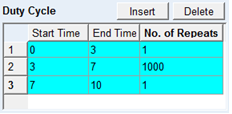
A more typical and interesting usage for "number of repeats" is when the Adams results represent a number of loading conditions to which, in reality, the bearing will not be subjected in the same proportions. For example, a 10-second Adams analysis may represent 3 seconds of start-up followed by 4 seconds of steady state and finally 3 seconds of shut off. An engineer might know in reality that the system will run in the steady state condition 1000 times longer than start-up and shut-down. So, to represent this one would define the duty cycle in Adams like so: