Create Chain - Silent
Machinery → Create Chain
L
For the option | Do the following |
|---|---|
If you select Linear compliance, the following options will be displayed: | |
Chain | |
Name | Enter the chain name. |
Axis of Rotation | Axis of Rotation can be one of the following: ■Orientation ■Pick (Marker) ■Global Z ■Global X ■Global Y |
Reference location | Enter the reference location. This will be used as a reference frame to build other chain components. |
Geometry | |
Total Links | Select to directly specify the number of links in the chain. By default, this is un-selected and Adams Machinery will automatically calculates the number of links for which, based on the chain routing, the lowest positive tension will result. This field is primarily intended for use-cases where a maximum of 1 or 2 extra links beyond the default calculated number of links is desired. Be advised that such models may have difficulty reaching a static equilibrium solution. Use of the static funnel technique may be necessary to solve for equilibrium. |
Link type | Select one of the following: ■Uniform Link - Use this option, if all links are identical, to specify the mass properties of one link. ■Multi Links - Use this option to specify the material properties of two link designs, which will alternate in the chain. |
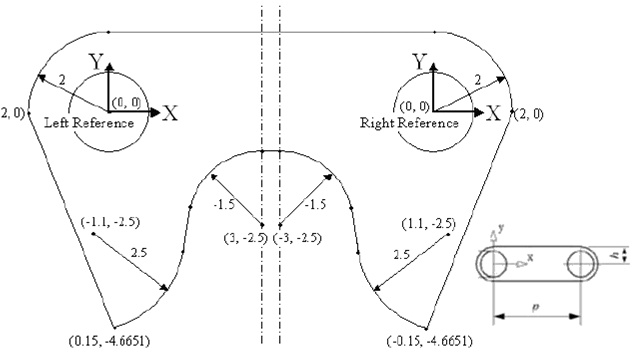
Chain pitch | Enter the distance, p, between the centerlines of the two rollers on a chain link. |
Chain width | Enter the width of the silent chain links. |
Pitch to back | Enter the distance, h, from the pitch line of the chain link to the edge of the plate that will be in contact with a guide. This distance will be used no matter how the chain link is defined. |
Section geometry | Select how many sections should be used to specify the left and right part of the link. Each section, will display three text boxes where you should enter the X and Y coordinates and the current radius. More details refer to Silent Chain Link Specification. Note: Sprocket outline must contain at least 10 values. |
Link stiffness Defining Chain Stiffness: Chain connection parameters defines the stiffness and damping coefficients of the bushing connecting two links. You can measure the chain tension by creating requests; see Create/Modify Chain Link Request or Create/Modify Span Request for Roller and Silent Chain. | |
Translational (X) | ■Stiffness Enter the stiffness of the chain link connections in x-direction (along the chain). This is the K[r1] value of a BUSHING statement, see the Adams Solver online help. The stiffness is in force units/length units. ■Damping Enter the damping coefficient of the chain link connections in x-direction (along the chain). This is the C[r1] value of a BUSHING statement, see the Adams Solver online help. The damping is in force units * time units/length units. |
Rotational (Z) | ■Damping Enter the rotational damping coefficient of the chain link connections around the z-axis; that is the center axes of the rollers. This is the CT[r3] value of a BUSHING statement, see the Adams Solver online help. The damping is in force units * length units * time units/angle units. |
Geometry settings | Chain Link ■None No link graphics will be present only rollers. Animations may perform faster with this option. ■Simple Simple link graphic is used. Animations may perform faster compared to using detailed link graphic. ■Detailed Fully detailed link graphic. Force graphics ■Enable Force graphic vectors will be displayed while animating results. ■Disable Force graphic vectors will not be displayed while animating results. |