FIELD
The FIELD command redefines and/or lists the data for a FIELD statement. You cannot redefine the I and the J markers, but you can redefine any other argument values.
Format
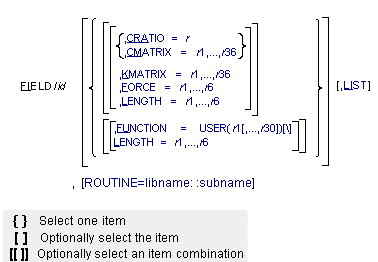
Arguments
CMATRIX=r1,...,r36 | Respecifies the six-by-six matrix of viscous damping coefficients. Enter the elements by columns from top to bottom, then from left to right. The units for the translational and rotational components of CMATRIX should be force-time per displacement unit and torque-time per radian, respectively. |
CRATIO=r | Respecifies the ratio of CMATRIX to KMATRIX. Adams Solver (C++) multiplies KMATRIX by CRATIO to obtain CMATRIX. |
FORCE=r1,...,r6 | Respecifies three preload force components and three preload torque components transferred by the FIELD element when the I and J markers are separated/misaligned by the values specified in the LENGTH argument. The terms r1,...,r6 are the force components along the x-axis, the y-axis, and the z-axis of the J marker and the torque components about the x-axis, the y-axis, and the z-axis of the J marker, respectively. FORCE is optional. |
FUNCTION=USER(r1[,...,r30]) | Respecifies the USER parenthetical list for a nonlinear field. Follow FUNCTION with an equal sign, the character string USER, and the values (r1[,...,r30]) that you want Adams Solver (C++) to pass to the FIESUB user-written subroutine. The FUNCTION argument is used, it must either be the last argument in the FIELD command or be followed by a backslash (\). |
KMATIX=r1,...r36 | Respecifies the six-by-six matrix of stiffness coefficients. The units for the translational and rotational components of KMATRIX should be force per displacement unit and torque per radian, respectively. Enter the elements by columns from top to bottom, then from left to right. |
LENGTH=r1,...r6 | Respecifies six reference length angles. This is the nominal position of the I marker with respect to the J marker, resolved in the J marker coordinate system. The terms r1,...,r6 are the x, y, and z translational components (specified in linear displacement units) of the displacement between the I and J markers; and a, b, and c are rotational displacement of the axes of the I marker with respect to the J marker, resolved in the J marker axes (specified in radians). If the reference force is zero, LENGTH is the same as the free length. |
LIST | Lists the current values of the data in the FIELD statement. |
ROUTINE=libname::subname | Specifies an alternative library and name for the user subroutine FIESUB. Learn more about the ROUTINE Argument. |
Tip: | Finite element analysis programs can give the values for CMATRIX and KMATRIX. |
Caution: | ■The three rotational displacements (a, b, and c) that define the field are not Euler angles. They are the projected angles of the I marker with respect to the J marker. Adams Solver (C++) measures them about the x-, y-, and z-axis of the J marker. ■For the constitutive equations to be accurate, at least two of the rotations (a, b, c) must be small. That is, two of the three values must remain smaller than 10 degrees. In addition, if a becomes greater than 90 degrees, b becomes erratic. If b becomes greater than 90 degrees, a becomes erratic. Only c can become greater than 90 degrees without causing convergence problems. For these reasons, it is best to define your field such that angles a and b (not a and c and not b and c) remain small. ■Adams Solver (C++) applies the component translational and rotational forces for a field to the I marker and imposes reaction forces on the J marker. ■The FIELD command allows you to define all six-component, action-reaction forces. However, when massless beams are being defined, you may want to use the BEAM command. It requires only six input values to compute the thirty-six values for the KMATRIX argument (see the BEAM statement). ■The K and C matrices must be positive semidefinite. In other words: xtK x > 0 for all non-zero displacements x, and ytC y > 0 for all non-zero velocities y. If this is not true, the stiffness matrix of the field may be removing energy from the system. Similarly, the damping matrix may be adding energy to the system. Both of these situations are uncommon. Adams Solver (C++) does not warn you if the C matrix, K matrix, or both are not positive semidefinite. While Adams Solver (C++) does not require that these matrices be symmetric, that is most realistic. |
See other Forces available.