Inverse Power Spectral Density (INVPSD)
Regenerates a time signal from a power spectral density description.
Format
INVPSD (Independent Variable, Spline Name, Min Frequency, Max Frequency, Num Frequencies, Use Logarithmic, Random Number Seed)
Arguments
Independent Variable or x | Independent variable |
Spline Name | Name of the spline containing the PSD data versus frequency. |
Min Frequency or f0 | Real variable that specifies the lowest frequency to be regenerated. |
Max Frequency or f1 | Real variable that specifies the highest frequency to be regenerated. |
Num Frequencies or nf | Real variable that specifies the number of frequencies. This number is supposed to be larger than 1 and less than 200. |
Use Logarithmic or linlog | Real variable that acts as a flag indicating whether the PSD data points are interpolated in the linear or logarithmic domain. The legal values are: ■yes (0) - linear domain ■no (1) - logarithmic domain |
Random Number Seed or Seed | Real variable that specifies a seed for a random number generator, used to calculate the phase shifts. During a simulation, PSD can be called with up to a maximum of 20 different seeds. |
Equation
Mathematically, INVPSD is calculated as follows:
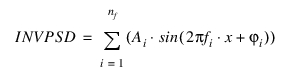
The regenerated signal consists of a series of sinusoidal functions where the amplitudes, Ai, are determined in such a way that the effective value for the PSD and the time signal are the same. The phase angle,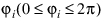 , is calculated by a pseudo-random number generator.
, is calculated by a pseudo-random number generator.Using the same seed value will always result in the same set of phase angles.
Example
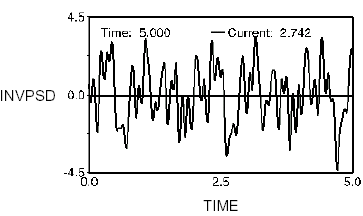
For the power spectral density data shown in Figure 1, INVPSD(TIME, spline_1, 1, 10, 20, 0, 0) regenerates the time signal shown in Figure 2.
Figure 1. PSD vs. Frequency in Log-Log Scale
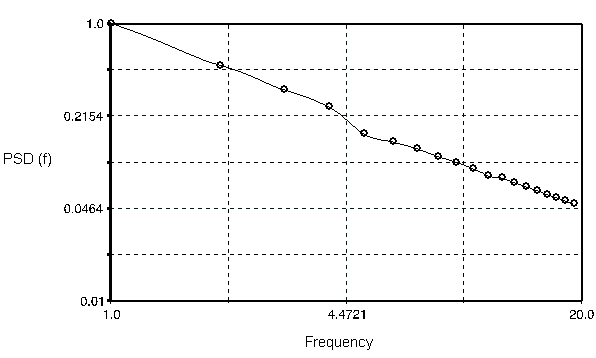
Figure 2. Regenerated Time Signal