Translational Joint Tool
Ribbon menu → Connectors tab → Joints container → Translational Joint Tool 
or
(Classic) Build → Joints → Translational Joint Tool
Creates a translational joint that allows one part to translate along a vector with respect to another part. The parts can only translate, not rotate, with respect to each other.
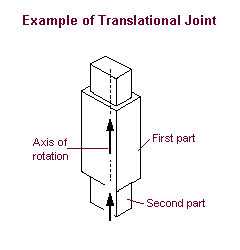
When you create a translational joint, you specify its location and orientation. The location of a translational joint does not affect the motion of the joint. It simply determines where Adams View places the joint. The orientation of the translational joint, however, determines the direction of the axis along which the parts can slide with respect to each other. The direction of the motion of the translational joint is parallel to the orientation vector and passes through the location.
Learn about:
For the option: | Do the following: |
|---|---|
1 Location (Bodies Implicit)/ 2 Bodies - 1 Location/ 2 Bodies - 2 Locations | Set how you want the joint connected to parts: ■1 Location (Bodies Implicit) - Lets you select the location of the joint and have Adams View determine the two parts that should be connected. Adams View selects the parts closest to the joint location. If there is only one part near the joint, Adams View connects the joint to that part and ground. ■2 Bodies - 1 Location - Lets you explicitly select the two parts to be connected by the joint and the location of the joint. The joint remains fixed on the first part and moves relative to the second part. ■2 Bodies - 2 Locations - Lets you explicitly select the two parts to be connected by the joint and the location of the joint on each part. You should use this option if you are working in exploded view. For more on exploded view, see Initial Conditions Tool. For more on the effects of these options, see About Connecting Constraints to Parts. |
Normal to Grid/ Pick Geometry Feature | Set how you want the joint oriented: ■Normal to Grid - Lets you orient the joint along the current Working grid, if it is displayed, or normal to the screen. ■Pick Feature - Lets you orient the joint along a direction vector on a feature in your model, such as the face of a part. |
First Body/Second Body (only appears if you select to explicitly define the bodies using the options 2 Bodies - 1 Location or 2 Bodies - 2 Locations explained above) | Set the bodies on which you want to attach the joint. Select either: ■Pick Body - Select to attach the joint to a body. ■Pick Curve - Select to attach the joint to a curve. If you select to attach the joint to a curve, Adams View creates a curve marker, and the joint follows the line of the curve. Learn more about curve markers with Marker Modify dialog box help. Attaching the joint to a spline curve is only available with Adams Solver (C++). Learn about switching solvers. |