Tire-Road Contact Methods
For the tire models (PAC89, PAC94, PAC2002, PAC-MC, Fiala, UA-Tire, 521-Tire, Air Basic, Air Enhanced, Air TRR64, Soft Soil tire model), Adams Tire has four different contact methods that model the contact in between the tire model and the road:
■One Point Follower Contact, default for 2D Road, 3D Spline Road, OpenCRG Road and RGR Road.
■3D Equivalent Volume Contact, default for 3D Shell Road.
■3D Enveloping Contact, can be used with all Adams road types.
■Tire Cross-Section Profile Contact Method, with PAC-MC tire only.
Below a brief description of each method is given including a flow chart to support in the use of the correct contact method.
Note: | FTire can apply its internal contact methods for all road types. |
One Point Follower Contact
The one point follower contact is the default contact method for all tire models (except FTire) in combination with 2D Road, 3D Spline Road, OpenCRG Road and RGR Road.
Considering the tire and rim as a disk, the contact point C is the point at intersection line in between the wheel center plane and the road tangent plane that has shortest distance to the wheel center.
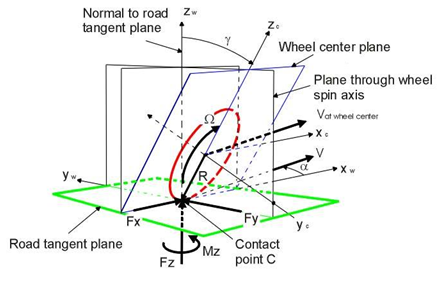
This type of contact is valid only for smooth roads that have obstacles with a wavelength larger than the tire's circumference.
3D Equivalent Volume Contact
The 3D Equivalent Volume Contact method can be used with 3D Shell Roads only. The 3D Shell Road utilizes a three-dimensional tire-to-road contact model that computes the volume of intersection between the road and the tire. From the intersection volume the method computes an equivalent plane's effective road normal, penetration, tire to road contact point, and effective road friction. The road is modeled as a set of discrete triangular patches (a triangle tessellated road representation), the tire as a set of cylinders.
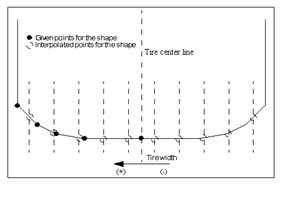
Similar to the 'One point follower contact', the 3D Equivalent Volume Contact is valid only for smooth roads that have obstacles with a wavelength larger than the tire's circumference.
For further details, see Adams Tire 3D Shell Road Model.
3D Enveloping Contact
When driving over road obstacles that have wavelengths shorter than the tire circumference, the tire enveloping behavior starts to play an important role. For modeling this non-linear obstacle swallowing effect the so-called 'tandem-egg' or 'tandem-cam' approach is used.
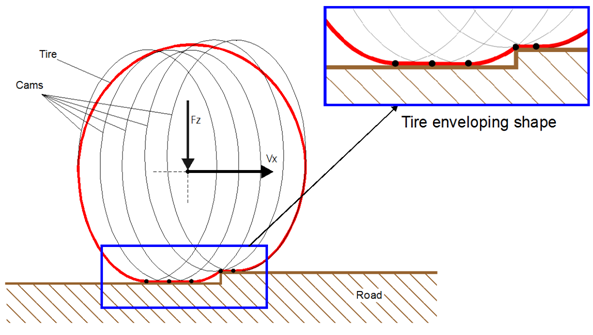
In the 'tandem egg' or 'tandem cam' approach a series of connected elliptical cams are defined which shape corresponds to the outside tire contour in the tire contact patch zone. During the simulation the contact of each cam with the road is determined. Then the sum of the position and orientation of all cams results in an effective height, effective slope, effective road curvature and effective road camber for the tire model.
For further details, see 3D Enveloping Contact.
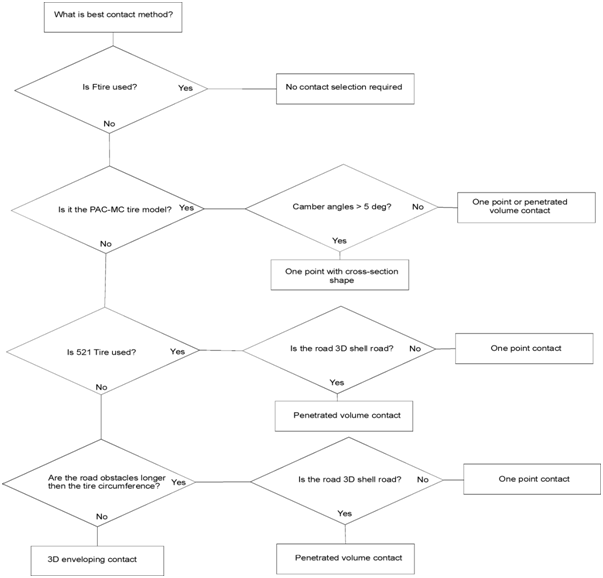
Flow chart for selecting the best contact method for your simulation.