Interactive Simulation Palette and Container
Simulation tab → Simulate →Click 
Main toolbox → Click
Main toolbox → Click
Display tools for controlling Simulation. The dialog box contains a complete set of simulation controls, while the Simulation container contains only a subset of the most commonly used simulation controls.
Simulation Container | Simulation Control Palette (from Simulation Tab) |
|---|---|
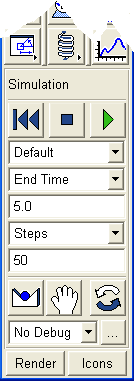 | 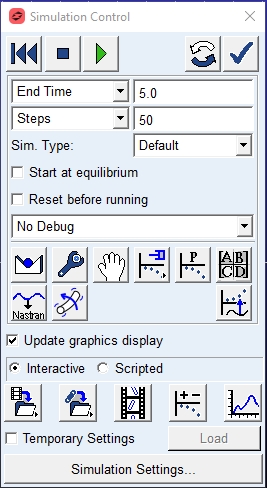 |
Learn about:
Icon | Description |
|---|---|
 | Sets your model back to its initial design configuration so you can modify your model or perform another simulation starting at time 0. You do not have to set the model back to its design configuration to continue simulating. You can pick up from the last frame of your animation and continue. Shortcut: Double-click the Select tool. |
 | Stops any further processing, and the modeling objects appear in the positions that Adams Solver last successfully calculated. |
 | Starts the Simulation. |
 | Replays an Animation of the last Simulation. Replaying an animation displays the results much faster than if you simulate the model again and watch the frames update as the solution calculates results. You can also replay an animation of a saved simulation; for more information, see Animation Controls. How Adams View replays your simulation depends on whether or not you have finished the simulation and reset the model back to its initial design configuration. ■If you have run a simulation, or part of a simulation, but not set the model back to its initial configuration, when you select to replay the animation, Adams View animates the model up to the last simulation step and leaves your model there. ■If you reset your model back to its initial configuration, when you select to replay the animation, Adams View automatically sets the model back to the initial design configuration when the animation is complete. |
 | |
Sim. Type | Sets the type of Simulation: |
End Time/ Duration/Forever | Enter the time interval over which the simulation takes place and set how you want it defined. You can select: ■End Time - Specify the absolute point in time at which you want the simulation to stop. ■Duration - Specify the amount of time over which you want the simulation to run. ■Forever - Adams View continues simulating until you stop the simulation or until it can no longer solve the equations of motion to within your specified tolerance. This option is only available on the Simulation Control dialog box. |
Steps/Step Size | Set the frequency with which Adams View outputs data during your simulation. You can specify: ■Steps - Represents the total number of times you want Adams View to provide output information over your entire simulation. For example, specify 50 steps over a 1-second simulation interval to define an output period of 0.02 seconds per step, which yields an output frequency of 50 steps/second. ■Step Size - Represents the amount of time, in current model units, between output steps. The output frequency remains constant even if you change your simulation end time or duration. For example, enter a step size of 0.01 seconds to specify an output period of 0.01 seconds per step, which yields an output frequency of 100 steps/second. |
 | |
No Debug/Eprint/Table | Select either: ■No Debug - Display no debugging information. |
More button  | Displays the full Interactive Simulation dialog box. |
Render | See Rendering mode. |
Icons | By default, Adams View turns off all Screen icons during animations to speed up the animation. To turn on and off icons:Shortcut: Type a lowercase v. |
Start at equilibrium | Select to have Adams View perform a static simulation before performing a dynamic simulation. |
Reset before running | Sets your model back to its initial design configuration before you run the Simulation. |
 | |
 | Allows the user to grab a part and drag it while the C++ Solver honors all of the model's constraints. Useful for quickly verifying a model's behavior. If this is attempted while a simulation is already running, the running simulation will stop. |
 | Displays the Compute Linear Modes dialog box. |
 | Displays the Perform Vibration Analysis dialog box. Only available when you have Adams Vibration. For more information, see the Adams Vibration help. |
 | Computes system linear modes with or without damping. See Linear Modes. |
 | Displays the Compute and Export Linear States dialog box letting you generate a state-space matrix representation of your mechanical system. |
 | Displays the Adams2Nastran dialog box allowing the export of a linearized NASTRAN model from Adams. |
 | Display the Run Rotor Dynamics dialog to launch a series of dynamic and linear eigen simulations. This is especially useful when the model contains flexible bodies with rotor dynamic definitions included in the MNF enabling the computation of local gyroscopic effects such as stress stiffening/spin softening due to high speed rotor dynamics. The results from this series of simulations can be explored via the Rotor Dynamics Campbell Plots in Adams PostProcessor. |
Update Graphics Display | Clear the selection to never have your model updated during the simulation. Select this when you are sure that your simulation will run to completion without difficulty, and you want to maximize the efficiency of the simulation. Learn about setting more options for simulation display with Solver Settings - Display dialog box help. |
Interactive/Scripted | Displays tools for controlling either an interactive or Scripted simulation. |
 | Save/Delete Simulation Results ■Left-click to display the Save Run Results dialog box so you can save the simulation results. ■Right-click to select a set of simulation results to delete. |
 | Save Simulated Position Displays the Save Model at Simulation Position dialog box so you can save the model at a simulated position into the Modeling database under a new name. |
 | Save Model at Simulation States Displays the Save Model at Simulation State dialog box so you can save the model at a simulated state into the Modeling database under a new name so you can use it as your new design configuration with states. |
 | Displays the Animation Controls dialog box. |
 | Displays the Linear Modes Controls dialog box. |
 | Displays Adams PostProcessor. |
Temporary Settings | Specify one or more Temporary Settings Files (.tsf) files. Property values contained in the file(s) will be applied before starting the simulation and then reverted to their original values immediately after the simulation finishes, even if the simulation fails to complete. Note that this field is only available if the Temporary Settings capability has been enabled from the AView-Preferences section of the Adams Registry Editor. |
Simulation Settings | Displays the Solver Settings dialog box, letting you set how you want the Simulation performed. |