Introducing Adams Tire
Adams Tire software is a module that you can use with Adams Car, Adams Solver, or Adams View for adding tires to your mechanical model in order to simulate maneuvers such as braking, steering, acceleration, free-rolling, or skidding. Adams Tire lets you model the forces and torques that act on a tire as it moves over roadways or irregular terrain.
Adams Tire is a set of shared object libraries that Adams Solver calls through the Adams GFOSUB and GSESUB subroutines. These subroutines calculate the forces and moments that tires exert on a vehicle as a result of the interaction between the tires and the road surface.
You can use Adams Tire to model tires for either vehicle-handling, ride and comfort, and vehicle-durability analyses:
■Handling analyses are useful for studying vehicle dynamic responses to steering, braking, and throttle inputs. For example, you can analyze the lateral accelerations produced for a given steering input at a given vehicle speed.
■Ride and comfort analyses are useful for assessing the vehicle's vibrations due to uneven roads with short wavelength obstacles (shorter than tire circumference), such as level crossings, grooves, or brick roads.
■3D contact analyses are useful for generating road load histories and stress and fatigue studies that require component force and acceleration calculation. These studies can help you calculate the effects of road profiles, such as pothole, curb, or Belgian block.
See the section Adams File Types for more information on Adams Tire extenision.
Adams Tire Modules
Adams Tire has a line of tire modules that you can use with Adams View, Adams Solver, and Adams Car. The modules let you model the rubber tires found on many kinds of vehicles, such as cars, trucks, and planes. More specifically, the modules let you model the force and torque that tires produce to accelerate, brake, and steer vehicles. The four modules available in Adams Tire are:
Adams Tire Handling Module
Adams Tire Handling incorporates the following tire models for use in vehicle dynamic studies:
The Adams Tire Handling models can deal with all road and tire-road contact methods.
*The formulae used in the Pacejka tire models are derived from publications, and are commonly referred to as the Pacejka method in the automotive industry. Dr. Pacejka himself is not personally associated with the development of these tire models, nor does he endorse them in any way.
Specific Tire Models
In addition to the tire models in the Adams Tire Handling Module, Adams Tire supplies specific tire models:
A Pacejka tire model suitable for motorcycle handling analysis. It describes the tire-road interaction forces with tire-road inclination angles up to 60 degrees.
A tire model that can predict the tire-road interaction forces on soft soil road surfaces using the existing Adams Tire Road descriptions.
Tire models that have been developed for aircraft tire modeling. However the Aircraft Basic and Enhanced tire model they can be used for other tire types as well.
FTire can describe the 3D tire dynamic response up to 120 Hz and beyond, due to its flexible ring approach for the tire belt. It can handle any road obstacle. In addition to FTire support of all Adams Tire Road modules, it can deal with the OpenCRG road and specific FTire road formats.
All tire models support the Adams Linear functionality.
Adams Tire Road Module
Next to an interface for user-written roads, the Adams Tire Road Module offers 4 types of roads that are supported by all Adams Tire models:
Adams Tire 2D Road
The Adams Tire 2D Road supports the description of roads with a range of two-dimensional obstacles.
Adams Tire 3D Spline Road
Adams 3D Spline Road lets you define an arbitrary three-dimensional smooth road surface. In addition, you can superimpose three-dimensional road obstacles, such as a curb, pothole, ramp, or road crown, on top of the underlying smooth road surface.
Adams Tire 3D Shell Road
Adams Tire 3D Shell Road describes a road surface by triangular meshed elements. The road can work with the default 3D Equivalent Volume Contact method or with the 3D Enveloping Contact.
OpenCRG Road
The OpenCRG Road is based on the open source road from the OpenCRG® organization (http://www.opencrg.org). OpenCRG provides a series of open file formats and tools for the detailed description of (measured) road surfaces.
Regular Grid Road
RGR road has been developed by cosin scientific software (www.cosin.eu) and is dedicated to measured 3D road surfaces similar to OpenCRG road. Next to the road library also tools are provided for generating, modifying and visualizing this road format.
Adams Tire Tire-Road Contact Module
Different methods are available to model the contact in between the tire and the road. For rather smooth roads (length of the road obstacles is larger than the tire circumference), the default One Point Follower Contact method can be used. For shorter obstacles the vertical tire response can show non-linear effects due to tire enveloping behavior. In such cases the 3D Enveloping Contact method should be used.
In addition a special method (Tire Cross-Section Profile Contact Method) is available for motorcycle tires, in which the effect of large camber is taken into account.
The fourth method, the 3D Equivalent Volume Contact method can be considered as a one point contact method as well, but it has advantages for road friction variations and meshed road surfaces.
Adams Tire Tools
Additional tools are provided to support the use of the Adams Tire modules:
■The Adams Tire Road Builder, for creating, modifying or visualizing 3D Spline Road profiles.
■The Adams Tire Data and Fitting Tool (TDFT), for calculating PAC2002 parameters out of tire measurement data or converting a tire property file to a PAC2002 tire property file.
Which Tire Model Should You Use?
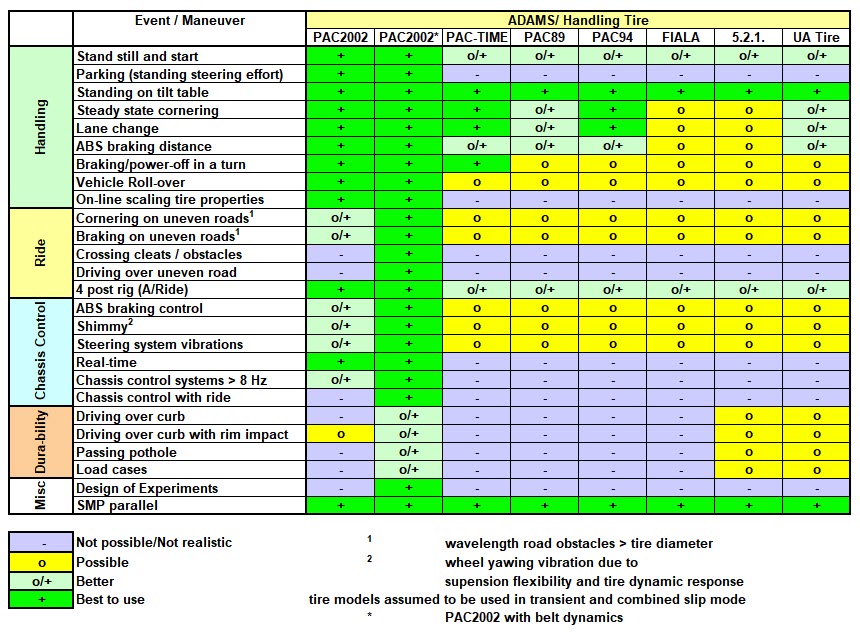
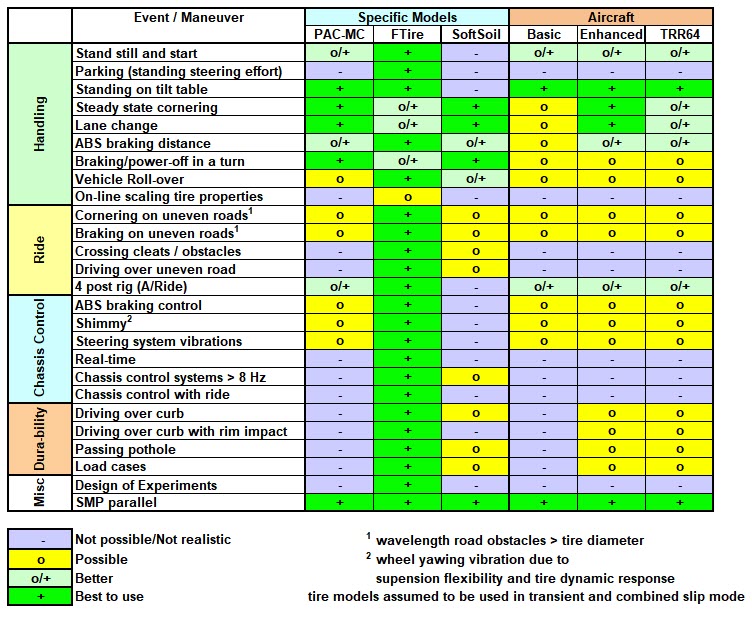
Each tire model is valid in a specific area. Using a tire model outside this area can result in non-realistic analysis results. The Typical Applications for Each Tire Model table indicates the tire model(s) that are the best to use for a number of applications.
The Handling Tire models can describe the first-order response of a tire, but do not take the eigenfrequencies of the tire itself into account. Therefore, the Handling Tire models are valid up to approximately 8 Hz. The PAC2002 can also use a more advanced transient method that extends the validity range up to 15 Hz. Beyond that frequency range, a tire model should be used that includes the dynamic effects of the tire belt. PAC2002 can offer also a basic approach of belt dynamics (rigid ring part) to increase validity up to 70 - 80 Hz; FTire is using a more complex approach with a more detailed contact patch and a flexible ring approach, which allows simulations to higher frequencies and a wider range of applications.
Typical Applications for Each Tire Model
Overview of the Adams Tire model features
In the table below an overview of all features of the Adams tire models are shown. Next to the tire and road model, the contact method plays an important role.
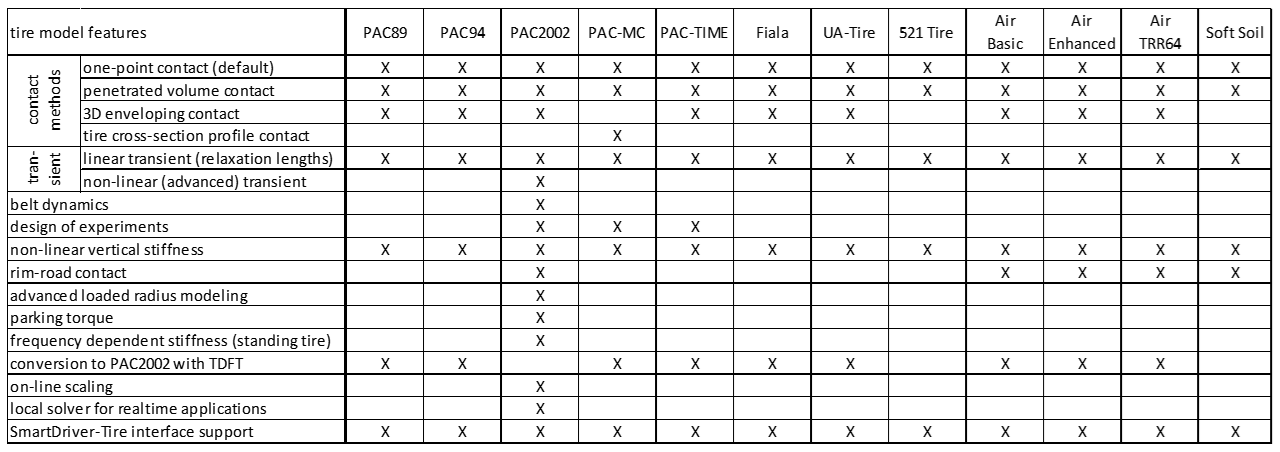
All the tire models can deal with all Adams road types, however not all contact methods can be used with all road and tire model combinations.
In general the One Point Follower, the 3D Equivalent Volume Contact and the Tire Cross Section Profile Contact are valid for rather smooth roads only: the length of the obstacles on the road should be larger than the tire circumference. The 3D Enveloping Contact can deal with any shape and size of road obstacles at all road types (2D Road, 3D Spline, 3D meshed, OpenCRG Road and RGR Road).
Adams Tire Tire-Road contact module
For the tire models (PAC89, PAC94, PAC2002, PAC-MC, Fiala, UA-Tire, 521-Tire, Air Basic, Air Enhanced, Air TRR64, Soft Soil tire model), Adams Tire has four different contact methods that model the contact in between the tire model and the road:
1. One Point Follower Contact, default for 2D Road, 3D Spline Road, OpenCRG Road and RGR Road.
2. 3D Equivalent Volume Contact, default for 3D Shell Road.
3. 3D Enveloping Contact, can be used with all Adams road types.
4. Tire Cross-Section Profile Contact Method, with PAC-MC tire only.
Note: | FTire can apply its internal contact methods for all road types. |
Transient Tire modeling methods In Adams Tire.
Within Adams Tire all tire models can calculate the tire force response in steady state mode (instantaneous tire response to input changes) or in transient mode. In transient mode a linear relaxation length approach is used. As an exception, the PAC2002 model also supports a non-linear transient approach valid up to higher frequencies (around 15 Hz).
In general the transient mode should be used, valid up to 7 Hz, unless the dynamic response of the tire is not importance or should be avoided (that is, plotting tire characteristics in the tire test rig).
Belt Dynamics
For increasing validity up to 70 - 80 Hz the PAC2002 tire model can use the belt dynamics feature: an additional part in the Adams model is used to add the dynamics of the tire belt so that the model dataset can be used for applications in the ride control area.
Vertical Tire stiffness
For modeling passenger car and truck tires a linear tire stiffness is adequate. In special cases (that is, low tire pressure or exposure to high vertical loads, for example with aircraft tires) a non-linear relation between vertical load and tire deflection can be specified in the tire property file for each tire model:
$---------------------------------------------------------load_curve
$ For a non-linear tire vertical stiffness
$ Maximum of 100 points
[DEFLECTION_LOAD_CURVE]
{pen fz}
0.000 0.0
0.001 212.0
0.002 428.0
0.003 648.0
0.005 1100.0
0.010 2300.0
0.020 5000.0
0.030 8100.0
See also the example tire property files in this manual and the Adams delivery.
Rim-Road Contact
The PAC2002 and the aircraft tire models can account for the contact in between the rim and the road using a basic approach. Based on cylindrical rim geometry, the location and orientation of the wheel a rim deflection is calculated, if applicable. Then the contact force results from the deflection - force input data given in the tire property file.
The Rim-Road contact approach is valid for roads having obstacles larger than the tire circumference.
See also the sections Wheel Bottoming in the PAC2002 and Aircraft tire manuals.
Advanced Loaded Radius modeling
In case the vehicle height (axle) height is important (that is, race applications), the PAC2002 offers a more advanced loaded and effective radius modeling. This method takes into account the effects of the longitudinal and lateral tire forces and tire rotational speed on the vertical tire stiffness and rolling radius, see Contact Methods and Normal Load Calculation.
Parking torque
The PAC2002 tire model is able to model the so-called 'parking torque' for a steering standing tire due to the friction in between the tire and road. In this advanced (non-linear) transient mode not only the parking torque comes into the model, but also the turn-slip effects due to turning at short turning radii and low speed. For further details see the section Non linear transient model in the PAC2002 manual.
Frequency dependent stiffness
The stiffness and damping rates for a standing tire can differ considerably from a rolling tire due to the different boundary conditions in the contact patch. While in many cases a rolling tire has low damping and a (almost) linear vertical stiffness, a standing tire has damping and stiffness rates that depend on frequency. The PAC2002 model enhances a Maxwell element that can introduce frequency dependent stiffness, see Non-rolling vertical tire stiffness and damping properties.
Design of Experiments
The PAC2002, PAC-MC, PAC-TIME and FTire model support the definition of DOE parameters within Adams Car and Adams View, see Adams Tire support for DOE.
On-line Scaling
In general the tire properties stay constant during a simulation. With the on-line scaling feature within PAC2002 it is possible to change the scaling factors that are available during the simulation according to any desired function. Because this requires a different setup of your model (needs a state variable for each scaling parameter), a detailed description can be found in the technical article KB8016467: http://simcompanion.mscsoftware.com/infocenter/index?page=content&id=KB8016467.
SmartDriver-Tire interface support
For vehicle modeling in Adams Car the SmartDriver-Tire interface insures that the exact same tire model is used for the Adams SmartDriver road preprocessing. User-written tire models can also support this interface, see KB8019634: http://simcompanion.mscsoftware.com/infocenter/index?page=content&id=KB8019634.